
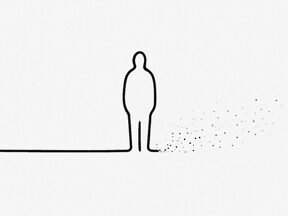
Before I got sick, I read the story of a physician whose daughter was complaining of persistent headaches so she took her in for an MRI thinking the likelihood of it showing anything serious was extremely low. The radiologist that read the exam called her back immediately as a professional curtesy and told her that her daughter most likely had a malignant brain tumor. She described entering this strange “in-between” state. As a physician, she was acutely aware of the suffering her daughter would endure undergoing treatment as well as the grim prognosis. She went from being a mother with a healthy child to a different person entirely, the person she was when she woke up that morning was gone forever. She was now living with the infinite possibilities and unknowns between her daughter’s diagnosis and eventual medical outcome.
The ”in-between” is a concept I revisited after my cancer diagnosis. It’s that intermediate state situated between two extremes. We are all, in a sense, living in many “in-betweens”, for example, the space between birth and death, shaped by the intermediate experiences that define our life’s arc. Other more simple examples include pregnancy and birth or applying to college and notification or filing for divorce and finalization. There are countless “in-betweens”.
A cancer diagnosis creates a different kind of “in-between”. The space between a diagnosis and a clinical outcome. You are no longer the healthy person who worries about mundane things like dinner or work projects, but you aren’t yet at a final destination (like death or complete remission). It is a state of perpetual, intermediate agony where your planned future is permanently deleted and replaced with a series of life-altering data points. This intermediate anguish knowing that you might never return to “healthy” or reach “death” immediately, but must instead learn to exist in the space indefinitely.
Where a layperson might see a straight line between getting cancer and getting well (or dying), as a cancer biologist, I see a complex graph. To a scientist, a data point is never the whole story; it is the trend, the deviations, and the variables “in-between” that matter. As a result, I can see the “in-between” as a space where there is still room for movement and change, even when the starting data point (an aggressive cancer diagnosis) is grim.
For most, the space between diagnosis and outcome is filled with the ambiguity. A typical patient might experience the “in-between” as a cloud of vague fears, I saw it through a lens of biological certainty, it was a high-resolution map of potential cellular resistance, aggressive biology and physiological decline. For the physician above and for me, it was filled with too much known. We both had more context and knowledge about the suffering in store. I couldn’t retreat into the hope that maybe it won’t be that bad, I knew exactly how bad it could be. It’s an anguish I struggled to escape, I could mentally forecast the emotional and physiological suffering in store.
My journey has taken me through every version of this “in-between”:
- From a healthy scientist and mother to a cancer patient.
- From an early-stage diagnosis to Stage IVB terminal cancer.
- And finally, the most complex transition: from terminal back to healthy.
Now that I am in remission, it doesn’t mean that I don’t suffer anxiety and fear, it is just less often. My cancer diagnosis has, to some extent, faded into the background. It is certainly still there with every routine chest abdomen, pelvis CT scan I have for surveillance. I have, however, stopped grieving my old “pre-cancer” life. I have embraced my reality and this murky “in-between” where I have learned to live my life intentionally with gratitude and sometimes joy.
